Talent & culture
Brocsoft in China: Joining Uruguay’s Official Business Mission with a Technology Agenda
As part of Uruguay’s official business mission to China, Brocsoft engaged in sector-specific exchanges and reflected on long-term opportunities for global talent collaboration.

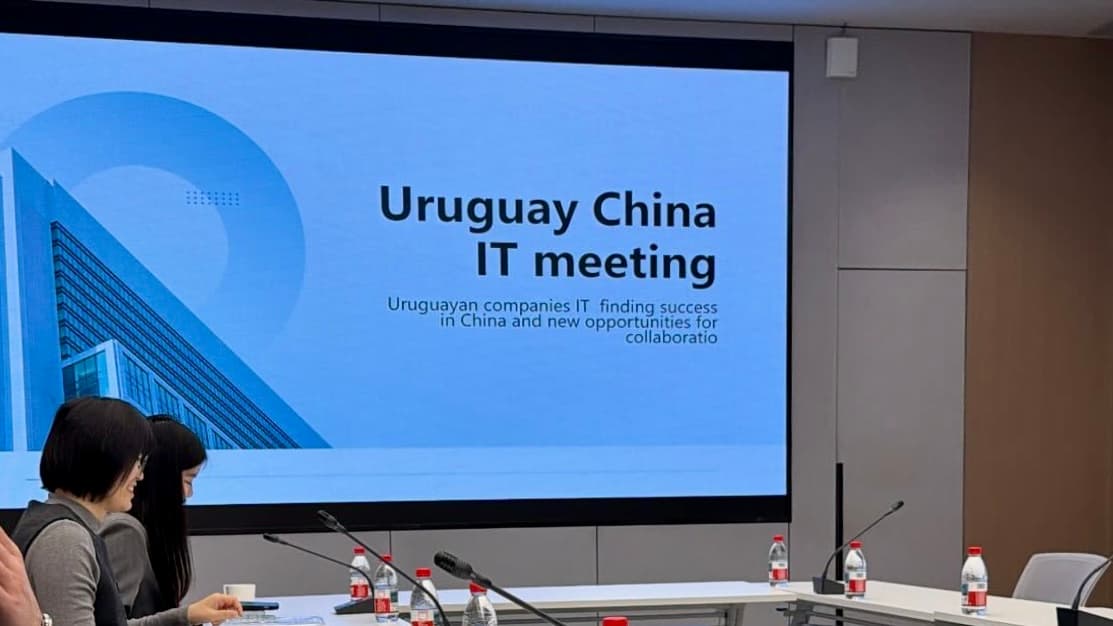
Between February 1 and 7, Brocsoft took part in Uruguay’s official business mission to China, organized by the Uruguayan government through Uruguay XXI and led by President Yamandú Orsi. The initiative brought together government representatives, public institutions, and business leaders from multiple sectors with the objective of strengthening bilateral relations and exploring new avenues for cooperation between both countries.
Throughout the week, the delegation participated in official meetings, business forums, and sector-specific exchanges in Beijing and Shanghai. These engagements provided valuable insight into China’s economic landscape, innovation ecosystem, and long-term strategic priorities.
Within this broader framework, dedicated sessions were organized for companies in the technology sector. These instances allowed Uruguayan firms to present their capabilities, engage directly with Chinese counterparts, and explore potential areas of cooperation.
One of the most relevant technology-focused moments was a business exchange organized by China’s investment promotion agency. During this event, companies from the delegation engaged with local firms, introducing their services, answering questions, and exploring potential collaboration opportunities.
This format enabled direct, one-on-one conversations and allowed Brocsoft to present its model within a broader international dialogue on talent and digital services.
The technology agenda also included meetings with Uruguayan companies currently operating in China, such as dLocal and GeneXus. These encounters provided practical insight into how firms from Uruguay navigate the Chinese market, adapt their models and build local presence in a highly competitive environment. Observing how these companies have structured their operations provided valuable perspective on market entry strategies, regulatory considerations, and the scale required to compete effectively in China’s digital ecosystem.
The visit to Huawei’s campus, however, stood out as the most significant technology milestone of the mission.
The delegation received a guided tour of the facilities and engaged in in-depth discussions around artificial intelligence and the evolving role of software engineers in this landscape.
Artificial intelligence emerged as one of the dominant themes of the exchange. Conversations focused not only on technological advancement, but on the structural transformation AI is expected to generate within engineering teams worldwide.
Reflecting on these discussions, Álvaro López shared:
“Huawei’s view is that engineers are not going to disappear because of AI. Developers will continue to play a critical role in building and guiding these systems.”
According to the perspective presented during the visit, artificial intelligence is not expected to eliminate engineering roles, but to redefine them. Automation may accelerate processes and increase efficiency, but strategic thinking, architecture design, and system integration will remain fundamentally human responsibilities.
For companies operating in global markets, this distinction is critical. The conversation is no longer about replacement, but about adaptation: about how engineering teams evolve alongside increasingly powerful tools.

Long-Term Positioning
Beyond the institutional agenda and the technology exchanges, the mission provided clarity on how different innovation ecosystems operate at scale. China’s market dynamics differ significantly from those of the United States, particularly in terms of time zone alignment and operational models. Traditional service exports face structural challenges in this context.
However, the experience also highlighted potential indirect opportunities. As Chinese technology companies expand into Latin America or North America, the need for engineering teams operating within aligned time zones may become increasingly relevant.
In that landscape, nearshore talent models can serve as a strategic bridge connecting global expansion strategies with specialized engineering capacity.
The mission to China was not centered on immediate commercial expansion, but on understanding how large-scale innovation ecosystems operate and where future collaboration opportunities may emerge. It offered perspective on market dynamics, the evolution of artificial intelligence, and the structural shifts reshaping global engineering teams.
For Brocsoft, the value of participating in initiatives like this lies in long-term positioning: observing how technology evolves at scale, identifying where talent can integrate into that evolution, and preparing for new forms of global collaboration.
As AI continues to redefine development processes, one conclusion stands out: the future of engineering will not be defined by replacement, but by transformation. And in that transformation, adaptability will determine long-term competitiveness.